

Why did God create us in diverse nations, races, and tribes? Two memorable Qur’anic verses, taken together, suggest an answer.
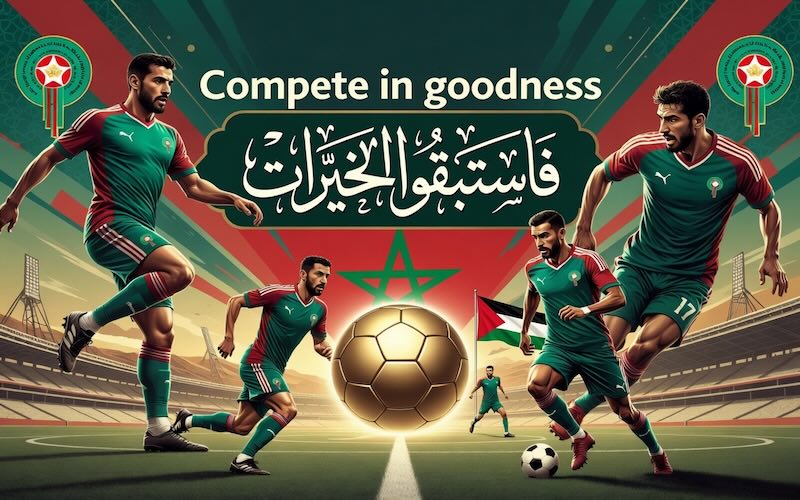
“…So compete with one another in doing good. Wherever you are, Allah will bring you all together [for judgment]. Surely Allah is Most Capable of everything.” (2:148)*
“O humanity! Indeed, We created you from a male and a female, and made you into peoples and tribes so that you may ˹get to˺ know one another. Surely the most noble of you in the sight of Allah is the most righteous among you. Allah is truly All-Knowing, All-Aware.” (49:13)
In today’s world, certain nations and tribes compete for wealth and power by striving to be the worst and the least righteous—lying, cheating, stealing, raping, torturing, and committing genocide far more than would seem to benefit them strategically. It’s like they think they are trying to win a contest to see who can be most “cartoonishly evil.”
Compared to that kind of competition, World Cup soccer seems benign and wholesome. As I reflect on the latest World Cup news—Morocco beats Netherlands in a thriller, Paraguay upsets Germany—it occurs to me that the notion of “competing in goodness” can be applied to the national identities represented by soccer teams.
Morocco has become a soccer powerhouse in recent years, reaching the final four in the 2022 World Cup and going on to win the Arab and Africa cups and the U-20 World Cup. Last night the Atlas Lions won a thrilling come-from-behind victory over The Netherlands. It was the first time an African team has ever beaten the Dutch.
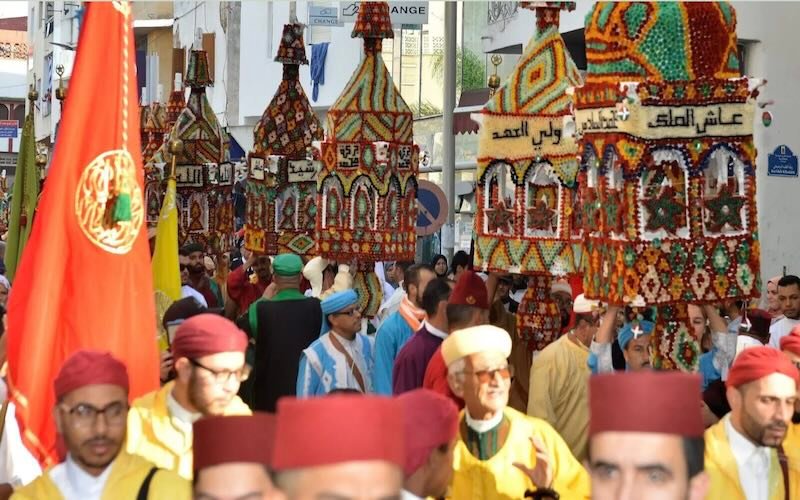
As in 2022, the Moroccans feature a world-class defense anchored by goalie Yassine Buonuo, who won the game with a final penalty kick save. As the Eastern Hemisphere’s best Global South team in the 2026 World Cup, Morocco has built a huge international fan base, and the crowd in Monterrey, Mexico was overwhelmingly dressed in red and cheering for the Atlas Lions. The Moroccan team’s habit of performing Sujood, the prostration of gratitude, after every match—win, lose, or draw—endears them not only to Muslims, but to everyone who appreciates spirituality and humility. And their history of flying the Palestinian flag, taken up by their fans, has earned them the appreciation of the overwhelming global majority that supports Palestine.
The Global South beat the North last night not only in Monterrey, but in Boston as well, where underdog Paraguay stunned Germany, also on penalties. Europe’s domination of soccer, like its domination of global politics, economics, culture, and military power, seems to be waning. (And just as European economies are kept afloat by immigrants from the Global South, so too their soccer teams succeed in large part thanks to dark-skinned immigrants.)
A minority of white Europeans rabidly hates immigrants, while a larger minority (perhaps even a majority) would like to see immigration reduced. Do these people cheer for their soccer teams, even though they’re full of immigrants? Google tells us:
In many European countries, far-right groups and anti-immigrant activists will passionately support a diverse national team, while simultaneously holding exclusionary political views for the rest of society. However, this paradox is often ignored in the unified moment of cheering for a victory.
Even the Islamophobic anti-Moroccan-immigrant Dutch politician Geert Wilders, who had been tossing out anti-Morocco provocations before the match, tweeted his congratulations to the Atlas Lions in the wake of their victory. Maybe he can convince his government to expel a few of the best ethnic-Moroccan Dutch soccer players and make the Atlas Lions even better.
It seems that most people, not just hardcore chauvinists, cheer for their own nation’s soccer team, whatever the ethnicity of the players. Issa Diop, who enabled last night’s Moroccan win by scoring an equalizing goal in the first minute of stoppage time, has a Senegalese father, but Moroccans could care less. Diop and Buonuo were the two most Moroccan guys in Monterrey last night.
So we all tend to cheer for our own team. But on what basis do we cheer for anyone else’s? Sometimes people support nearby nations’ teams based on geographical proximity and cultural affinity: Koreans support the Japanese, Middle East Arabs and even Algerians support the Moroccans, and so on.
Others cheer for underdogs. Gotta love plucky little Paraguay!
And then there’s politics. Everyone I know was cheering for Iran in this year’s World Cup (and in their war on the Axis of Epstein). When Trump’s immigration goons kept abusing the Iranian team, going so far as to not even let them sleep on US soil, it just increased the world’s sympathy for the Islamic Republic’s footballers. And when dubious refereeing decisions, and a possibly rigged tie between Algeria and Austria, conspired to eliminate Iran, it just cemented the Iranians’ status as the world’s favorite team.
Another reason to cheer for or against a team is one’s general impression of that country. I cheer for Morocco not only because I love their sujood ritual and Palestine flag, but because I live here and like the place and its people. Moroccans are strikingly friendly and hospitable. The culture has a strong undercurrent of spirituality. The cuisine is incredible. The linguistic and cultural diversity is amazing. There’s a kind of flexibility and openness in the Moroccan personality that I find appealing.
Booing Canada
And as much as I hate to admit it, I’m going to enjoy cheering against Canada when Morocco plays them on the Fourth of July. What do I have against Canada, you ask? Well, for one thing, they have refused me entry about half the times I have tried to go there since 2017. Though I have crossed back and forth into Canada many dozens of times since the 1970s, starting in 2017 at the behest of the ADL and the Bronfman crime family that owns it, and Canada they began harassing me at the border and (sometimes) denying me entry, using the ridiculous pretext that I was supposedly arrested for drug possession in Waukesha, Wisconsin in June 1977—which in fact never happened. They claim that because their record shows the arrest, but no disposition, I might be a fugitive “on the lam” from a minor drug arrest that never happened almost 50 years ago. What’s more, two of the Canadian officials I have discussed this with at the border were incredibly rude, belying their nation’s reputation for politeness.
The Bronfman Crime Family’s barring me from their wholly-owned subsidiary, Canada, symbolizes for me the pathetic failure of that nation to live up to its potential. Decades ago, Canada was cool. From 1938 to 1974 Canada had a genuinely public bank, which financed infrastructure projects directly so Canadians didn’t have to pay usury to the Rothschilds to build roads, bridges, railways, and dams. Pierre Trudeau, whatever you think of him or his misbegotten son, welcomed American draft dodgers during the Vietnam era and defied the Americans by cozying up to Castro. Canadian movies used to be better than their Hollywood counterparts, and other cultural production was likewise notable, thanks in part to a national cultural policy complete with at least a modicum of funding. Quebec’s francophone culture is rich, vibrant, and fun. And of course Canada has decent single-payer healthcare.
These and other things helped Canada sell itself as “the North American country that is NOT the United States.” We US citizens could travel around the world and pretend to be Canadians so people wouldn’t despise us.
But now, Canada won’t even call Gaza a genocide, though it thinks there is one in Xinjiang. It’s 100% Kosher Nostra owned, with the Bronfmans running it on behalf of the Rothchilds who have had their vampire squid tentacles in the Canadian taxpayers’ debt since 1974. There’s no free speech—look at what happened to Tony Hall. The COVID lockdowns were, if anything, even worse in Canada.
Admittedly, Canada has recognized Palestine, picked a few minor fights with Trump, and says it doesn’t want to be invaded. But as far as I can tell, The Other North American Country isn’t doing much to demonstrate that it’s any better than that hellhole to the south. If they let me cross the border next time maybe I’ll revise my opinion.
France Isn’t Much Better
France, like Canada, was better when it was an alternative to the American Empire. Under de Gaulle it had its own identity, excellent education and cultural production, and the ability to say non to Washington and Tel Aviv. And under Chirac, France questioned 9/11 and refused to join Bush’s criminal, Israeli-inspired war on Iraq.
Today, Macron is moronically sleepwalking into World War III against Russia. That’s probably because he, like the rest of the country, is owned by the Americans and the Zionists. Like Carney in Canada, Macron’s France recognized Palestine, but won’t cut relations with Israel.
French culture no longer has a critical edge. There are still a few actual French intellectuals, like Laurent Guyénot and Emmanuel Todd and Yusuf Hindi, and some cool provocateurs like Dieudonné and Alain Soral, but they have been marginalized. France still has a reasonably engaging leftist presidential hopeful, Melanchon, who compares favorably to American and Canadian candidates, but his odds of winning are low.
So despite my deep-seated affection for the French language and culture, I see no reason to forgive France for beating Morocco in the 2022 World Cup quarterfinals.
I Kind of Like Spain
If I had to live somewhere other than Morocco, Spain would be high on the list. Like Morocco, it has great food (though not as great for the price), friendly people (though not quite as friendly as Moroccans), and a historically rich and deep-rooted culture with a spiritual vibe represented by folks like St. Teresa of Ávila, St. John of the Cross, and before them, the Andalusian Sufis like Ibn Arabi. And though Spain may not be as friendly, tasty, diverse, or spiritual as Morocco, it scores higher on dependability, organization, work ethic, and so on. What’s more, the Spanish government, not just the people, strongly supports Palestine. In short, my impressions of Spain are all positive, which is why I travel there often, and even hope to rev up my Spanish to full fluency some day. I’ll definitely cheer for Spain when they play Austria tomorrow.
Enough Small Talk
I began by quoting sublime verses from the Qur’an, but have wandered off into ever-more-trivial small talk about soccer and impressionistic takes on countries and cultures. Rather than continue in such a petty and inconsequential vein, I am going to sign off and find a Moroccan sidewalk café with a big screen TV featuring today’s World Cup matchup.
*The idea of “competing in goodness” also features in 5:48 and 23:61.